
Open source · Apache License 2.0
Start from a working website foundation, not from zero.
Foundation is a real website base that already routes, presents, localises, indexes and deploys. A business starts from it so the expensive fundamentals exist on day one — and keeps ownership of its identity, content and branding.
- Open source under the Apache License 2.0
- No account, subscription or platform lock-in
- Deployed from your own account to your own domain
- A real codebase, not a no-code builder: someone technically competent still sets it up and deploys it
What changes for a business
Not architecture — outcomes. These are the differences a business actually notices.
You start ahead
The common website fundamentals already exist and already work: page structure, navigation, metadata, accessible interface behaviour and a deployment path.
Business facts stop being scattered
Your name, tagline, languages, navigation, contact surfaces and feature choices are settings rather than code spread across templates, so a change happens in one place instead of five.
Identity and content stay under your control
Your branding is a defined set of files and your pages are your own writing. Both remain separate from the system underneath, so the system can move without rewriting your business.
Services connect instead of being rebuilt
Booking, enquiry delivery, maps, analytics and the systems you already run stay where they are. Your website presents the business and hands visitor intent to them through defined connections.
You choose the implementation route
Implement it yourself, hand it to your own developer or agency, or ask Provelopment for help. All three are legitimate and none of them is a downgrade.
What stays yours
Foundation is infrastructure you hold rather than a service you rent, and the split is deliberately plain.
Yours
- Your business name, description and identity
- Your branding, logo, imagery and artwork
- Your content, in your own words
- Your locale set and your translated dictionaries
- Your provider choices for booking, enquiry, maps and analytics
- Your hosting account, domain and deployment
- Everything you or your supplier add afterwards
What the licence means
- Apache-2.0 covers Foundation's own code and documentation.
- You may use, modify, distribute and commercially exploit it, including inside your own proprietary website.
- It is a copyright licence: rights in the Provelopment name and logos are not granted with it.
- There is no licence fee, account or renewal to keep using your site.
You do not receive exclusive ownership of Foundation's original code — it stays open source for everyone. What you own outright is your site: its configuration, its content, its branding and everything either of you adds.
What Foundation handles
The reusable system underneath your website. Each entry is stated as what it means for the business first.
Reusable presentation
Your pages look consistent and deliberate from the first day, because the layout, spacing and typography system is already built.
Under the hood: A design-token presentation layer with shared section, grid and heading composition.
Routing and content machinery
Your pages are found at stable addresses without anyone hand-wiring links or rebuilding navigation when a page is added.
Under the hood: A page content model with locale fallback, read through an application port.
A responsive shell
Header, navigation and footer work on a phone, a tablet and a desktop without a second implementation to maintain.
Under the hood: A configurable navigation composition resolved once through the shared shell engine.
Localisation capability
Adding a language is content work — a dictionary file and a content directory — rather than a development project.
Under the hood: Interface dictionaries validated against a schema, with locale negotiation at the request boundary.
Discovery and metadata machinery
Search engines and social previews receive correct titles, canonical addresses and structured data without anyone remembering to add them.
Under the hood: Per-route metadata, Open Graph data, structured data and a content-derived sitemap.
Validation
A mistyped setting is caught before it can reach your visitors, with a message naming the value that is wrong.
Under the hood: Strict schema validation of configuration and dictionaries at build time.
Integration seams
Booking, enquiry delivery, maps and analytics can be switched on, swapped or turned off without disturbing the website itself.
Under the hood: Ports and adapters behind per-capability factories, selected from configuration.
Verification infrastructure
Changes are checked automatically, so a later edit is far less likely to quietly break a page nobody looked at.
Under the hood: An assets check, type check, lint, unit and architecture tests, a production build and a real-browser matrix.
What it does not try to replace
Foundation presents your business and hands visitor intent to your systems. It deliberately stops before the systems themselves.
- Your CRM and customer records
- Your accounting and invoicing
- Your payment ledger and card processing
- Your operational booking or scheduling database
- Your customer accounts and sign-in
- Your wider business platform
These are boundaries, not gaps. A website that tried to become all of them would be harder to own, harder to change and harder to hand to someone else.
Ways to use Foundation
Three legitimate routes. They are equally valid, and none of them is required.
Do it yourself
The repository ships adoption, customisation, branding, content, validation, deployment and troubleshooting manuals. Following them is the primary path, and it is complete.
Use your own developer or agency
Everything your business changes lives in configuration, content and assets, so any competent web developer can take it on — including one who has never seen Foundation before.
Ask Provelopment for help
Optional implementation and support are available if you want them. Adopting Foundation and never contacting Provelopment is a completely successful outcome.
Whichever route you take, you finish holding the source of your own site.
Proof, from real sites
Foundation is demonstrated by two materially different businesses running on the same foundation. They are not clients and not case studies — they are the project's own proof that one foundation serves genuinely different organisations.
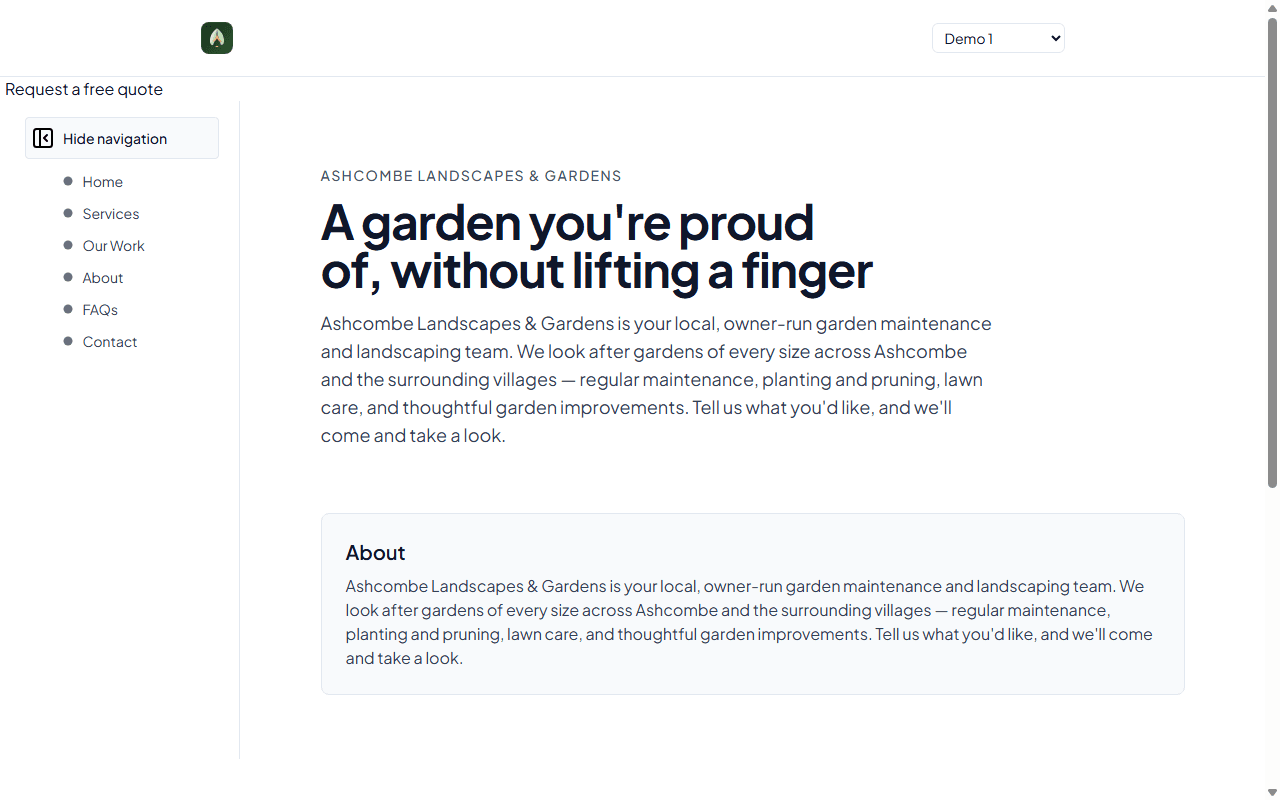
Service business with project work
Ashcombe Landscapes & Gardens
A quote-oriented path, service pages and a project showcase — a business that has to show finished work before it is believed.
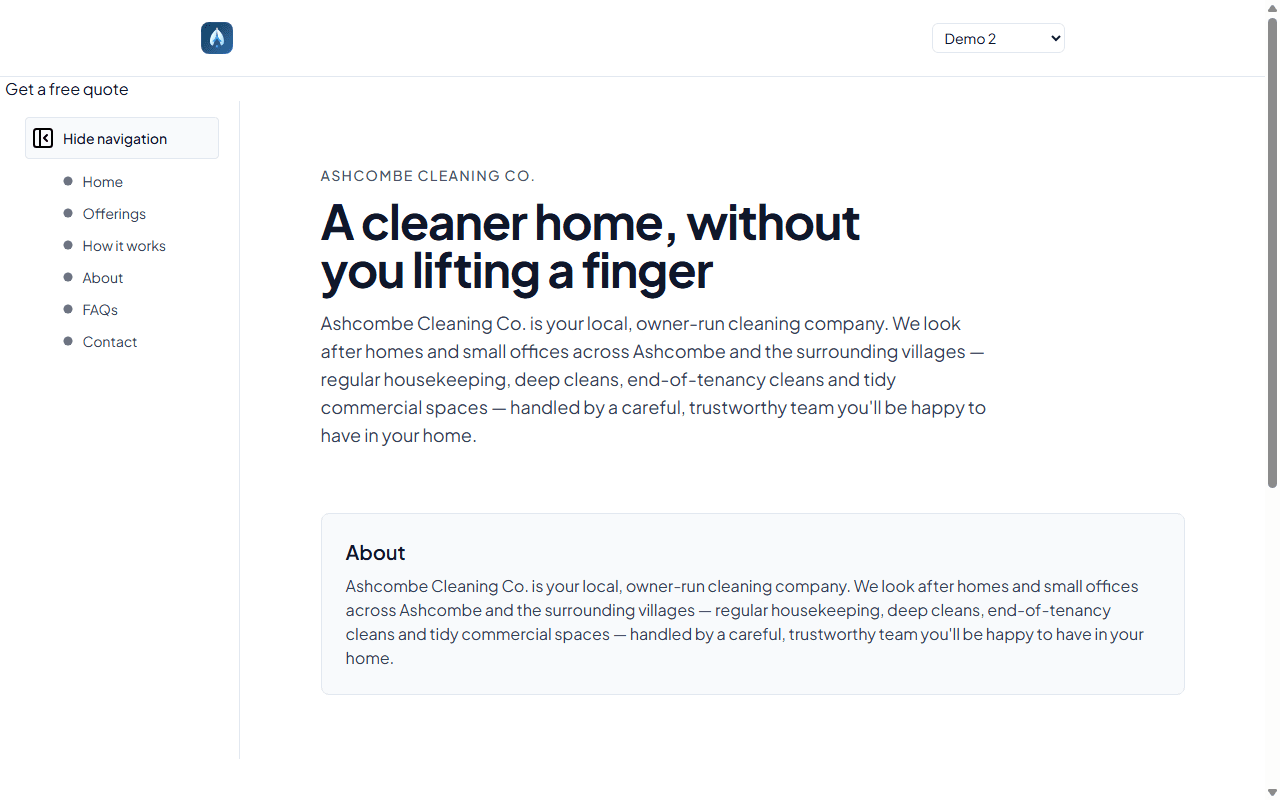
Recurring-service business
Ashcombe Cleaning Co.
A simpler recurring-service shape: fewer capabilities enabled, a shorter path from arrival to enquiry, and its own branding.
Both are fictional businesses created to exercise the foundation on realistic content. Their value is architectural: two different businesses with two different feature mixes, one foundation, and no fork in the code.
See it for yourself
Two different businesses, one foundation. Look at what it produces, then start from it.